Search This Blog

Saturday, December 5, 2015

TRUJILLO, PERU


Trujillo is a coastal city located in northwest Peru on the banks of the Moche River and site of the great prehistoric Moche and Chimú cultures before the Inca conquest. Trujillo is in close proximity to two major pre-Columbian archeological sites: Chan Chan, the largest adobe city in the ancient world and designated a World Heritage Site by UNESCO in 1986; and the Temples of the Sun and the Moon, the largest adobe pyramid in Peru.

Our shore excursion today would include a visit to both of these sites and was organized by Darla Bernard from New York, who I connected with thru the Cruise Critics board.  Darla located our guide at the end of the pier and our group quickly formed, loaded onto our van and headed out for day of adventure.

View of Temple of the Sun ruins from hike up to the Temple of the Moon
Our first stop would be the Temple of the Moon.   This site is located about 2.5 miles from  Trujillo.  Strangly, we drove right past Huaca del Sol, the Temple of the Sun, without stopping.  This site was partially destroyed and looted by Spanish conquistadors in the 17th century, while the Huaca de la Luna, Temple of the Moon, was left relatively untouched.  Archeologists believe that the Temple of the Sun may have been used for administrative, military, and residential functions, as well as a burial mound for the Moche elite.  The Temple of the Moon served primarily for ceremonial and religious functions, though it contained burials as well.

Beginning of our hike up the hill to Temple of the Moon ruins
Our stop was at the Temple of the Moon and as we walked past the entrance and began our ascent up the long, steep dirt path to the ruins, I was struck by the total lack of color around me with the exception of the soft brown of the adobe brickwork.  At the time of construction, this site would have been decorated in murals painted in black, bright red, sky blue, white, and yellow, truly a site to behold for sure. Unfortunately, the sun and weather have since faded the colorful murals.

Many of the later bricks used in the structure bear one of more than 100 different markings believed to correspond to different groups of laborers from different communities.   Each group was assigned a mark to put on their bricks, and these were then used to count the number of bricks laid for, presumably financial and, I would guess, competitive purposes.  I can envision a nightly conversation amongst the men with the repetitive questions of “How many bricks did your team lay today?” or “Tomorrow I bet our team can lay more bricks than your team.”  Must be that male competitive thing. 

The complex seemed to consist of three main platforms and areas.  The northern platform, at one time brightly decorated with a variety of murals, was destroyed by looters.  The central platform displays burial grounds for the Moche religious elite. Finally, the eastern platform is the site of human sacrifice rituals.  After the sacrifice, bodies would simply be hurled over the side and left exposed.  Multiple skeletons of adult males have been discovered at the foot of the rock, all of whom showed signs of trauma, normally a severe blow to the head as the cause of death.


Freedom Monument Fountain in Trujillo
After leaving this site we headed to downtown Trujillo.  Very typical of most cities in this part of the world, the Main Square revolves around the Freedom Monument Fountain which commemorates their Proclamation of Independence of 1820.   We took a brief 20 minutes here soaking in the sights, sounds and smells of this bustling area and then headed off to our next stop, the Chan Chan ruins. 


One of the colorful building in downtown Trujillo


Chan Chan is an archaeological site located about 3 miles west of Trujillo and was the capital of the historical Chimú culture. This fascinating civilization grew out of the remnants of the Moche civilization.  The adobe city of Chan Chan was the largest in the world, built around 850 CE and lasting until the Inca conquest in 1470.  It was also the imperial capital with over 30,000 inhabitants.  The city has ten walled citadels which houses ceremonial rooms, burial chambers, temples, reservoirs and residences.  It is triangular in shape and surrounded by 50–60 foot high walls.  The walls are adobe brick covered with a smooth surface into which intricate designs are carved.   


Our group spent a good hour here then made our way back to the ship for our 3:00pm sailing.  


Friday, December 4, 2015

PUNTARENAS, COSTA RICA


The port of Puntarenas sits on a very long and narrow peninsula jutting out from the western side of Costa Rica.  The pier itself is extremely long and very narrow, two buses wide plus a few feet.  My best guess would be more than a football field in length.  I understand there to be a free pier shuttle but we never saw one.   What we did see as we stepped off the gangway was at least a dozen or more buses lined up on the pier like soldiers at attention.  It looked like a train down the entire length of the pier.  Each bus had to back down the entire length of the pier due to it’s very narrow width.   Unfortunately for us, another cruise ship docked at the same time of our arrival so the pier quickly became very congested.  The situation quickly became one of the most poorly organized and frustrating experiences of any port I have ever been in, which is numerous over the past 37 years of traveling.

Our shore excursion for the day was arranged by Pat Ansley who we connected with through the Cruise Critics board.  We were instructed to meet with our tour operator Gio Tours,  at the bottom of the gangway at 8:00am.  Our group numbered about 14 and included one in a wheelchair and 2 with canes.  To set the scene - the day was extremely hot and humid, even at 8:00am.   By 8:15am our Gio Tours guide, with group dutifully following behind like ducks in a row, began making our way down the pier, hugging the rail to avoid the constant movement of buses.  Once we had cleared the shadow cast from the cruise ships, the sun became brutally hot.  I had taken an umbrella with me, not because I thought it was going to rain but for this exact situation.  It proved to be invaluable and a very wise choice. 

After we had walked about half way down the pier our guide suddenly stopped and told us we must now wait here.  We would not be allowed to walk off the pier but instead must stand on the pier and wait for our assigned bus with no shade, no seats and clinging as close to the rail as possible so buses could come and go.   As time passed and tempers flared, some couples finally left our group and decided to go off on their own.   The thought certainly crossed my mind several times.  Finally our assigned bus began backing down the pier but it was now 9:05am and we had been over 1 hour standing in the sun waiting.  We actually began moving off the pier at 9:30am, an hour and a half behind schedule.  

Our guide, whose name was Dixon, graciously took a barrage of negative comments from those of us that decided to wait it out.  Luckily for Dixon once we finally boarded tempers began to calm quickly as the bus was well air conditioned, in excellent physical and mechanical condition and we were immediately given a bottle of ice cold water.  

Keep those arms inside the boat
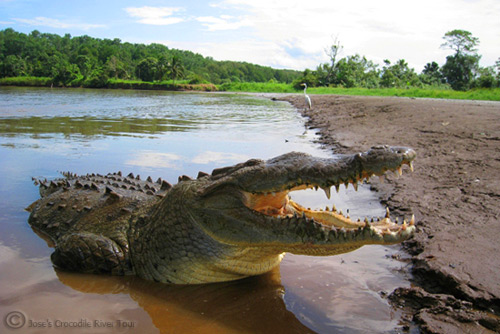
The tour description indicated we would have an 8 hour tour but since we had to be back on the ship by 4:30pm we were only going to get 7, obviously something was going to be left out.   Our first stop would be Jose’sCrocodile River Trip.   Located on the Tarcoles River, our drive time was one hour to reach our boarding point. The next 1 hour river cruise proved to be a true highlight of the day.   This tour definitely takes you up-close and personal with the American crocodile.   The boat sits fairly low in the water with the sides also low so keep those hands inside the boat.  In addition to several crocodiles we also viewed several birds and other wildlife.  Staff entice the crocodile with chicken and are able to bring the crocodiles right up next to the boat.  

The American crocodile up close and personal

Daily feeding of chicken bring them right to the boat


Steve-n-Lisa's roadside restaurant
At the conclusion of our boat tour we then drove a short 15 minutes to our lunch stop, Steve-N-Lisa’s Restaurant.  I have not found a website or facebook page for them but I did rate them on Trip Advisor.  I also have a phone number of 2637-0665 if you find yourself in the area.  This roadside restaurant is a convenient stop with free wi-fi and our meal consisted of rice, beans, salad, picadeo (potatoe mix), and our choice of chicken, beef or fish.  I opted for the fish, which was a breaded marlin and cooked to perfection.  


From here we drove another 20 minutes to the El JardinOrotina souvenir shop which I could have done without.  The store was clean, very large and served samples of local coffee.  All the typical touristy things to buy.  I checked out several of the items but felt the prices were definitely high.   I’m sure that the tour operators probably get a kickback for stopping here so I get it, just would rather have done something else.  Luckily it was only a 20 minute stop.  

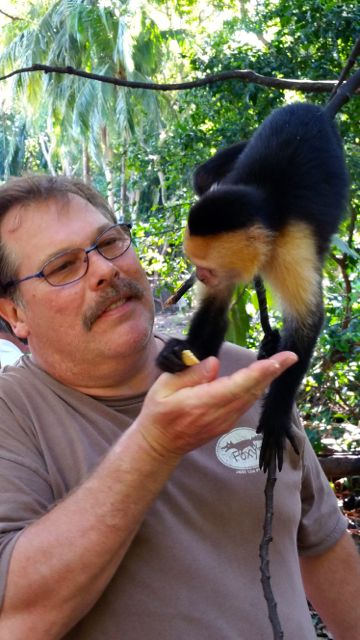
White-headed Capuchin Monkey
On our drive back to Puntarenas we stopped at Laroca in Caldera to check out some wild monkeys and kuatimundi.   This was certainly a wonderful experience.  Here you will be able to interact with a group of 27 white-headed capuchin monkeys and at least 2 kuatimundis.  The monkeys are very mischievous and playful and will climb on your head and shoulders trying to get the bananas away from you so guard your glasses and cameras.  I did see one woman lose her sunglasses to one playful little guy. 
Kuatimundi
Hang on to those cameras and glasses
Add caption


Time was quickly approaching 4:30pm so we left the monkeys behind and began making our way back to the ship while taking in some last minute views of the beautiful beaches that Costa Rica has to offer.  Our sailing was 5:00pm. 


Thursday, December 3, 2015

PUERTO QUETZAL, GUATEMALA (ANTIGUA)


You will find that your stop in Puerto Quetzal will simply be a place for your ship to dock as the immediate area holds little interest for cruise passengers.  There is a market dockside but you are going to want to leave the area to find anything of interest.  We opted to go to Antigua.  This is the one time that I booked a shore excursion through the cruise ship company.  I opted for the “Antigua On Your Own” which was the round-trip bus transportation only.  The cost was $51 per person but felt it would be best to use the NCL transportation in the event there would be any problems getting back to the ship on time.  Cruise companies will hold a ship for passengers booked on their shore excursions but will not wait for independent travelers. 

Antigua is 90 minutes away by bus and is designated as a UNESCO World Heritage Site.  It is most famous for it’s well preserved Spanish Baroque-influenced architecture as well as a number of ruins of colonial churches, the first of which was begun in 1545.  The city boasted a peak population of about 60,000 back in the 1770’s with the bulk of the population moving away in the 18th century.  By 1850 the population had dwindled to a mere 9,000 and currently runs about 30,000.  The city is laid out in a square pattern with a central square, called Parque Central, and streets running north to south and east to west.

Antigua is also known as a destination for people who want to learn Spanish through immersion. There are many Spanish language schools in Antigua, and it is one of the most popular and best recognized centers for Spanish language study by students from Europe, Asia and North America. Language institutes are one of the primary industries of Antigua, along with tourism.

The city of Antigua is surrounded by three enormous volcanoes.  The most commanding is Volcan de Agua (Volcano of Water) which is located to the south of the city at a height of 12,356 feet.  To the west of the city are a pair of peaks, Acatenango, which last erupted in 1972, rising some 13,045 feet high, and the Volcan de Fuego (Volcano of Fire), some 12,346 feet high.  Volcan de Fuego is famous for being almost constantly active at a low level as we witnessed on our way to and from Antigua.  Steam and gas spew from its top daily with a larger eruption last occurring in September 2012.   

View of Volcan of Fuego (Volcano of Fire) on our way to Antigua
As our bus arrived into the downtown area of Antigua we found ourselves dropped
Making us tortillas at Rincon Tipico Restaurant
in front of the Jade Maya.  We had no interest in shopping at this very touristy place so we began walking to the Central Park area, only 2-3 blocks away.  As we slowly began making our way to Central Park, taking in all the sights and sounds that Antigua has to offer, we walked past Rincon Tipico restaurant.   Although the restaurant doesn’t have a webpage, throughout the day it became very apparent that this was “the place to eat” in Antigua.  

 We watched at the entrance to the restaurant as they made homemade tortillas at the front door, cooking them on a large round grill.   We bought 2 to try them out at a cost of $1 Quetzel - $0.13 cents in US dollars. 

 
Local selling handcrafted items in Central Park

We took our piping hot, freshly baked tortillas and headed down to Central Park.  This area is beautiful but chaotic.  People, people everywhere with more locals than I could possibly count, dressed in bright colors and all of them trying to peddle their handiwork.  In a very short time your mantra for the day will become “No”. 
Adorable girl selling necklaces


Explaining what type of cut I wanted with the dog keeping me in check.
After leaving the Central Park we walked carefully down the cobblestone streets and came across a beauty salon named Dorka’s.  How bad could it be I thought to myself.   I felt it time to get my hair cut and what could be more fun and interesting than to have it done in Guatemala, figuring if I didn’t like it that it would grow out in a month.  The experience turned out to be delightful.   On top of the friendly and engaging staff you couldn’t help but fall in love with their ‘mascot’ dog that sat in one of the chairs as if to say “This is my house and I am in total control here so don’t even think about trying anything.”   The haircut turned out fine and cost a mere $10 USD for a wash, cut and blow dry.  Such a bargain and such a fun experience.  It was here that my friend Marci, very fluent in Spanish, discovered that the Rincon Tipico Restaurant was the best place to eat for the locals.  Since it was now almost 1pm we decided to go back to the restaurant and give it a try. 

 
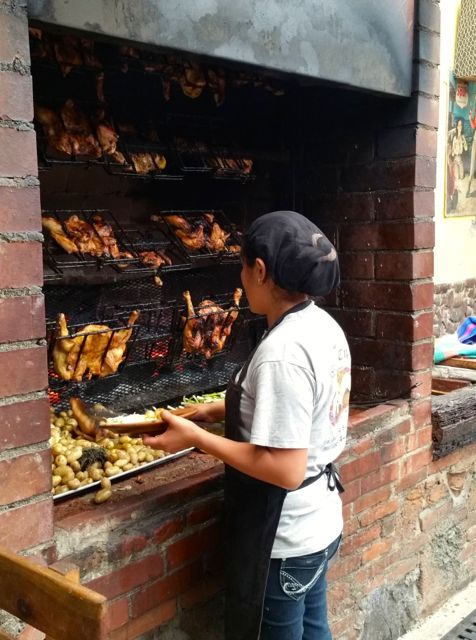
Chicken roasting over open flame wood.


As we walked into the very narrow restaurant and began looking for a seat, we noticed that we were the only tourists in the place.  Definitely a local hangout and the smells of the chicken roasting made my mouth water.  Both Marci and I opted to have the daily lunch special.  This included roasted chicken, cooked over open flame wood, small round potatoes, flavored by the drippings from the chicken, salad and Horchata, a local rice drink.  The total cost for our lunch was $30 Quetzel, about $3 US Dollars per person.


After lunch we walked a short couple of blocks to a local pharmacy where I made a purchase of an item the locals call “Magic Cream”.  I had asked for a hydrocortisone cream to relieve the itching from the bug bites I picked up at Hagia Sofia.  The cost was $8 US Dollars and it worked just like “magic”. 

At this point we managed to commandeer a tuk-tuk for a 30 minute city tour at a total cost of $10 US Dollars.  You can easily see the city in 30 minutes but a word of caution, because the roads are all cobblestone, your insides will feel like a blended milkshake when you are done.  Don’t consider doing this if you have any type of back problems.    


Mermaid fountain in Central Park

Horse drawn carriage rides available in downtown

Local architecture of downtown Antigua

San Pedro Hospital

City Hall

Local architecture of downtown Antigua


When our city tour was complete we asked our driver to drop us at his favorite spot so we could have a local beer before returning to the ship.  Both Marci and I burst out in laughter as, you guessed it, he pulled up in front of Rincon Tapico.   We ordered a local beer at a cost of $3 US Dollars. 

As time was getting away from us we opted to hire yet another tuk-tuk to get us back to the Jade Maya, our bus pickup point.  We left Antigua promptly at 3:00pm, arriving back to the docks at 4:35pm and sailed away at 6pm.  


Wednesday, December 2, 2015

PUERTO CHIAPAS, MEXICO


View through our window as we approach Puerto Chiapas, Mexico
Arriving via cruise ship into Puerto Chiapas affords one a feeling of peace and tranquility.  Palm trees swaying in a gentle breeze, fountains, lush green and perfectly manicured grounds, a dozen national flags standing at attention in stark white place holders and a sparkling blue swimming pool makes Puerto Chiapas my pick for the most scenic of all the ports on this itinerary.  Even though this port was built in 1975 and has undergone 2 name changes, one would think that construction was completed just before your arrival.   

View from Deck 7


Swimming pool available for cruise passengers

Although beautiful to look at as glide gently into port  via cruise ship, the town of Puerto Chiapas holds little in the way of touristic interest.  There is a craft market as one leaves the dock but you will want to leave the port to find any points of interest in the area.   If you have not pre-arranged your shore excursion, either from the ship or through a private company, you are going to find the port small, crowded and ‘total chaos’ as you attempt to arrange your transportation.  With only one taxi kiosk available you will first stand in a very long line, then reserve and pay for your transportation and then WAIT for your number to be called announcing the arrival of your transportation.  Kinda reminded me of a day at your typical Motor Vehicles Department.   

Originally I had thought our shore excursion to the Izapa Ruins and Mayan Calendar Observatory had been pre-scheduled and reserved by Elaine and Allen Child, a couple we connected with thru the Cruise Critics board.  Unfortunately this proved to be a misunderstanding which resulting in a wait time of over an hour and a half to secure local transportation.  After much confusion and frustration our van finally arrived.  We had contracted for 3 hours at a cost of $20 per person.  Finally our party of 6 loaded into our white van and pulled away from the port.  I glanced down at my cellphone.  It was now 12:30pm and we were finally headed out to the ruins.

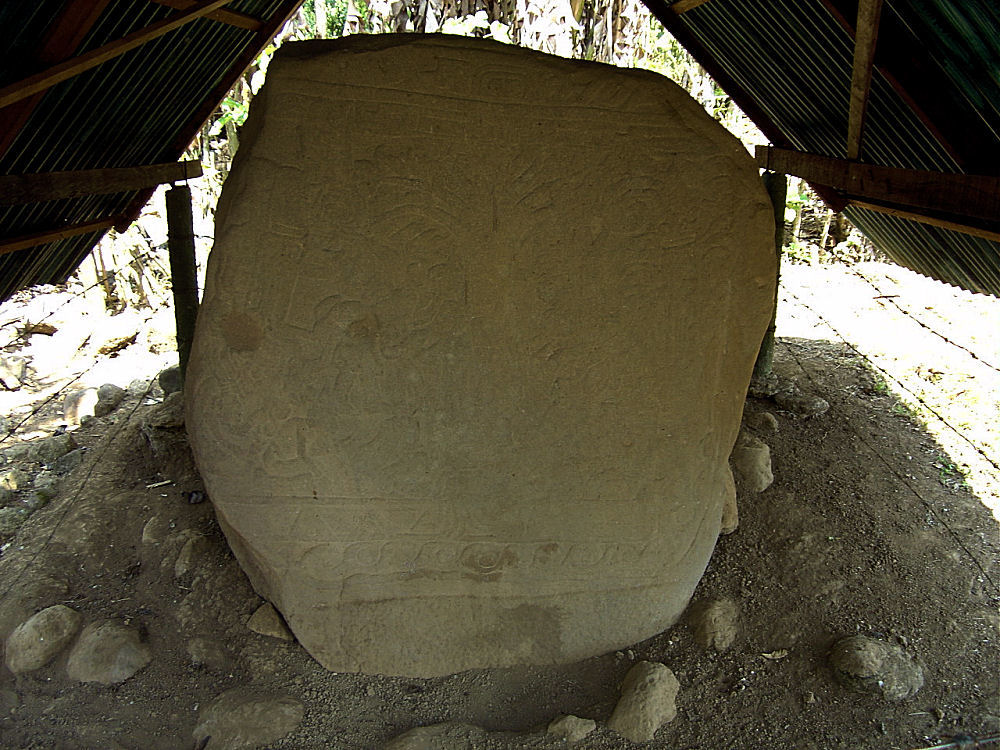
Travel time from the pier to Izapa ruins takes about 45 minutes.  To our delight no entrance fees were collected.   The grounds are a large pre-Columbian archeological site whose beginnings can be traced back to around 1500 BC.  Originally just a very small village, Izapa grew into the region’s most influential cultural and commercial center with a population of possibly up to 10,000 people at the height of its influence, sometime between 60 BC and AD 100. Once foremost in the region for the production of highly valued cacao, Izapa brought together many of Mesoamerica’s ancient cultures and many believe it to be the original site of the sacred Mayan Calendar.  You will want to spend a minimum of 30 minutes here and then consider driving another 5 minutes to the lesser known Group A and Group B sites.  The group A location is where you will find Stela 5, known as the “Tree of Life” stone.  Though not as grand as some of the other Mayan ruins, I think you will be pleasantly surprised with your visit. 


Panoramic photo taken from one of the many mounds at Izapa Ruins


Enjoyed the day with some of our new cruise friends Rick and Darla


Stela 5 "Tree of Life" Stone


Stela located at Group A location

From the Izapa ruins we headed to the Tapachula Planetarium.  Here we were introduced to Mayan Cosmology and also enjoyed a Mayan folkloric performance.  As we sat in preparation for the viewing, we reclined our seats to a near flat position, affording a full view of the domed planatarium ceiling.  The lights slowly dim and finally you find yourself sitting in total darkness.  Next you will enjoy the 15 minute audio-visual presentation on the stars and how they were used by the Mayans in building their cities and temples.   At the conclusion of the presentation, after allowing ample time for your eyes to adjust to the light,  you can head outside the building to watch a traditional Mayan Leopard Warrior dance.   


Inviting the crowds to watch the performance
Mayan Leopard Warrior
At the conclusion of the folkloric performance we again loaded into our van and headed back to our ship.  We pulled dockside just as our 3 hours was concluding.  Another beautiful and informative day comes to a conclusion.


HUATULCO, MEXICO


Anne and Miles Howe from Australia
Today’s shore excursion was arranged by Anne and Miles Howe.  Anne quickly proved to be an effervescent individual with great organizational and leadership skills and I immediately found myself drawn to her feisty personality.  Anne and Miles proudly hail from a tiny speck on the map called Norfolk Island, Australia.  Today we would be a small group of 10 and Anne had arranged for a van to pick us up at the end of the pier.


Located on the South coast of the Mexican Pacific Ocean in the State of  Oaxaca,  Huatulco has a coastline that extends over 20 miles and boasts 9 different bays including: Cacaluta, Chachacual, Chahue, Conejos, El Organo, San Augustin, Maguey, Santa Cruz and Tangolunda.  With a warm subtropical climate, the average temperature hangs around 82 degrees with 330 days of sunshine a year. These conditions foster lush growth for many species of Mexican plants. 

Arriving into Huatulco, Mexico

Our shore excursion today was to Hagia Sofia.  From the Greek meaning “Holy Wisdom”, Hagia Sofia is a 320-acre agro-ecological project located at an altitude between 850-1280 feet above sea level.  Our van ride was a little difficult, taking just over an hour and sprinkled with lots of bumps, ruts and topas (Mexican speed bumps).  The last part of the trip was via a dirt road that ends at the ‘heart’ of Hagia Sofia.  We were graciously greeted with flavored water drinks and light fruit.  My favorite quickly became the hibiscus water.


Hagia Safia in the Sierra Madre Mountains

Outside kitchen area at Hagia Sofia

Greeted by flavored waters and various samples of local fruits


We learned about organic sustainable farming as applied to exotic fruits and flowers from Southeast Asia and Mexico as well as the cultivation of rare timber trees native to Mexico.  Their interpretive trail, called the “Path of Flowers”, is approximately 550 yards long and is home to a wide diversity of flora and fauna.


Marci Inman and Sharon Sparlin on the "Path of Flowers" walk.


Local vegetation bearing my name


After completing the “Path of Flowers” interpretive trail, we loaded up in the van and drove the short distance to the falls for a quick swim.  Our drive took us across the Magalana River and provided wonderful view of the Sierra Madres.  Once our van stopped we were faced with a short and rocky hike to the base of the falls.  They seemed small to me compared to those I am used to seeing in Oregon, but were impressive non the less.  About half of the group opted to jump into the waters created by the falls.  After spending about 15-20 minutes here we then hiked back to the van and drove back to the main pulse of Hagia Sofia for our pre-arranged lunch. 


I selected the fish

The traditional lunch included tortillas, chips and salsa, rice, pot beans and cactus, along with a choice of chicken, fish or vegetable stew.  I opted for the fish which proved to be a great choice.  We also had the opportunity to try locally grown and processed coffee.  All of the plates and cups were hand crafted from local area clay and are used exclusively throughout Hagia Sofia.  Everything at Hagia Sofia is ‘natural’, right down to the organic bug spray we used. 

During lunch we met the owner of Hagia Sofia, Victor “Armando” Canavati Nader.  Armando was born in Monterrey, Mexico.  His father is Lebanese and his mother is from Bethlehem.

On our return to the ship we made a photo stop for an elevated  view of our ship. It was a glorious and informative day.